
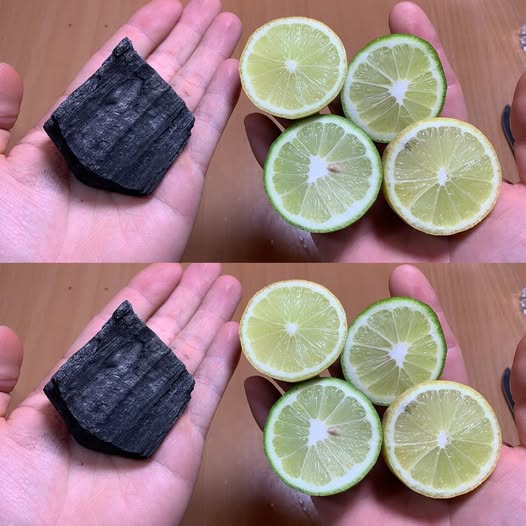
Just mix LEMON in CHARCOAL and you no longer need to spend money at the market
Every month, she had been spending more than she was willing to acknowledge. Not on anything ostentatious, just the commonplace items. The teeth-whitening toothpaste that never quite lived up to expectations. The cleanser for clogged skin. The deodorant was effective until it stopped working. The spray for washing shoes ran out more quickly than it should have. For tough stains, use the kitchen scrub.
Month after month, they all added up to a sum that caused her to pause.
Then a neighbour told her about a mixture she had been using for over a year. Two ingredients. Both incredibly inexpensive. Mixed together in different ratios for different purposes — and between them, replacing almost everything on that list.
She tried it the same evening.
Within a week, she had stopped buying four of the products entirely. Within a month, the number was six.
This is the mixture. And this is everything it does.
Why This Combination Is So Extraordinarily Versatile
Each of these two ingredients is already remarkable on its own. But each has a quality that makes the other exponentially more useful.
The first is one of the most powerful natural adsorbing substances ever discovered. The word is adsorb — not absorb — and the difference matters enormously. Where absorption draws a substance in, adsorption attracts and binds substances to its surface through a process driven by electrical charge. This first ingredient has a porous structure so vast that a single gram of it contains a surface area of up to 1500 square metres — meaning it can bind, trap, and neutralise an extraordinary volume of compounds it comes into contact with.
It binds toxins and bacteria on the surface of the skin, drawing them out of pores before rinsing them cleanly away. It adsorbs the volatile organic compounds responsible for odours — not masking them but eliminating them at the molecular level. It polishes surfaces with a fine, controlled abrasive action. It whitens — including the surface of teeth — by binding the tannins and pigment molecules responsible for staining and lifting them physically away. And it does all of this without chemicals, without synthetic compounds, and without any of the ingredients that make the labels on most commercial products so difficult to read.
Its one limitation is that it needs a delivery medium — something to carry it, bind it into a usable consistency, and add complementary action alongside it.
That is where the second ingredient becomes everything.
The second is rich in citric acid — a natural alpha hydroxy acid that exfoliates, brightens, dissolves mineral deposits, and creates a slightly acidic environment in which the first ingredient’s adsorbing properties are activated and enhanced. Its vitamin C adds antioxidant protection to skin applications. Its acid cuts through grease, limescale, and surface tarnish in household applications. And its juice thins the first ingredient into a workable paste — one that spreads smoothly, stays where it is applied, and rinses cleanly without residue.
Together they create a paste that whitens, detoxifies, deodorises, exfoliates, cleans, and polishes — across the skin, the teeth, and the surfaces of the home with a versatility that almost no single commercial product can match.
What You Will Need
Activated charcoal powder ( available in capsules that can be opened, or loose powder )
Fresh lemon juice — always freshly squeezed for maximum vitamin C and acid content
A small clean bowl for mixing
The ratio varies by use — specific amounts are given below for each application
What to Use It For and How
For whiter teeth Mix half a teaspoon of activated charcoal powder with enough fresh lemon juice to form a smooth, spreadable paste. Apply to the teeth using a soft toothbrush, working gently across the surface of each tooth. Leave for two minutes — no longer — then rinse extremely thoroughly with water until the mouth is completely clear. Use once a week at most. The charcoal binds the pigment molecules responsible for staining; the lemon’s citric acid adds a brightening effect. Most people notice visibly whiter teeth after two to three uses.
For deep skin cleansing and pore clearing Mix one teaspoon of activated charcoal with enough lemon juice to create a smooth paste. Apply to the face avoiding the eye area, leave for 10 minutes, then rinse with warm water and follow with cool water to close the pores. The charcoal draws bacteria, excess sebum, and debris from deep within the pores; the lemon exfoliates the surface and brightens uneven skin tone. Use once a week on oily or congested skin.
For natural deodorant Mix one teaspoon of activated charcoal powder with a few drops of lemon juice and a teaspoon of coconut oil until a smooth paste forms. Apply a small amount to clean, dry underarm skin. The charcoal adsorbs the bacteria responsible for odour at the molecular level; the lemon creates an acidic environment that further inhibits bacterial activity. Allow to dry before dressing. Remarkably effective and entirely free of synthetic compounds.
For whitening and cleaning grout Mix two teaspoons of activated charcoal with enough lemon juice to form a thick paste. Apply along grout lines with an old toothbrush, leave for five minutes, scrub firmly, and rinse. The combination lifts staining and mineral deposits from grout in a way that most commercial tile cleaners struggle to match.
For removing stubborn stains from cups and surfaces Apply a small amount of the paste to stained mugs, sinks, or kitchen surfaces with a damp cloth. Rub gently and rinse. Tea, coffee, and limescale staining lifts quickly and cleanly.
For deodorising the fridge or musty spaces Place a small open container of dry activated charcoal powder — no lemon needed for this application — inside the fridge or any enclosed space with an odour. Replace every four weeks. The charcoal adsorbs odour molecules from the air continuously and silently.
What This Habit Replaces and What It Saves
whitening toothpaste. cleanser for clogged skin on the face. natural deodorant. cleanser for grout and tiles. Scrub the surfaces in the kitchen. refrigerator deodorizer.
Six items. There are two components. a price that is minuscule compared to the total value of those six items.
It is not necessary for the shelf to be as full as it has been. Additionally, the money that has been flowing to the market each month for items that can be produced in a matter of minutes using just two basic components should be put to greater use.
Combine them once. Observe their actions. Next, determine what you still need to purchase.