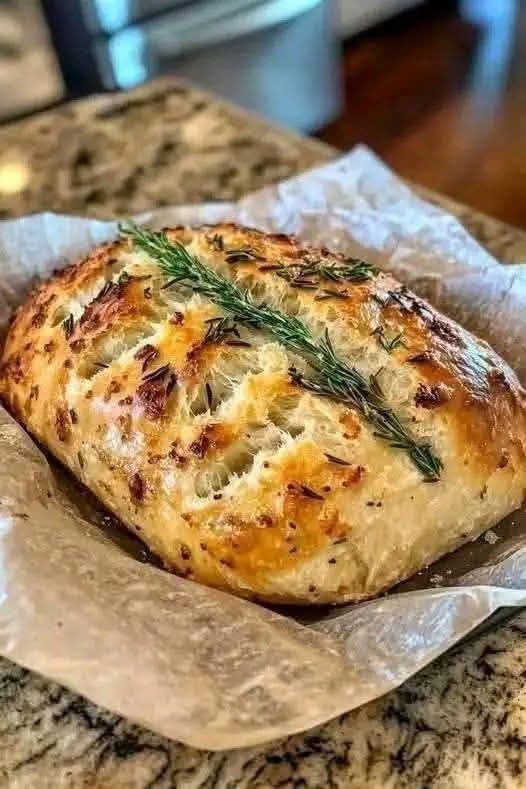
🥖 Rustic No-Knead Rosemary Garlic Bread
Description
This rustic no-knead bread is fragrant, crusty, and incredibly simple to make. Fresh rosemary and roasted garlic infuse the dough with deep, savory aroma, while the long fermentation yields a chewy, airy crumb and a bakery-style crust — all with almost no effort. Perfect for beginners or seasoned home bakers who want artisan-quality bread without kneading.
🍞 Ingredients
For the Dough
-
3 cups (360g) all-purpose flour (or bread flour)
-
1 ½ teaspoons salt
-
½ teaspoon instant yeast
-
1 ½ cups (360ml) warm water
Flavor Add-Ins
-
2–3 cloves garlic, minced (or 1 bulb roasted garlic for sweeter flavor)
-
1 tablespoon fresh rosemary, finely chopped (or 1 teaspoon dried)
-
Optional: 1 tablespoon olive oil for added richness
👩🍳 Instructions
1. Mix the Dough (No Kneading!)
-
In a large bowl, mix flour, salt, and yeast.
-
Add water and stir until a sticky, shaggy dough forms.
-
Fold in rosemary and garlic (raw or roasted).
-
Cover with plastic wrap or a damp towel and let rest at room temperature for 12–18 hours until doubled and bubbly.
2. Shape & Rest
-
Dust a surface with flour.
-
Gently turn out the dough — do not punch it down.
-
Fold the edges over once or twice to form a loose ball.
-
Place on parchment paper, cover, and rest for 30–60 minutes.
3. Preheat the Dutch Oven
-
Preheat oven to 450°F (230°C) with a Dutch oven inside for 30 minutes.
4. Bake
-
Carefully lift the dough with parchment into the hot Dutch oven.
-
Cover and bake for 30 minutes.
-
Remove lid and bake another 10–15 minutes until golden and crisp.
5. Cool
Let the bread cool at least 30 minutes before slicing (it finishes cooking inside).
🌿 Chef’s Notes
-
Long fermentation creates the deep flavor — don’t rush it.
-
Roasted garlic gives a sweeter, buttery flavor; raw garlic gives a sharper, more pungent taste.
-
Bread flour makes a slightly chewier loaf; all-purpose makes it more tender.
💡 Tips for Best Results
-
Wet dough = airy crumb. Don’t add extra flour even if it seems sticky.
-
Use parchment paper to prevent sticking and for easy transfer.
-
To add extra crunch, spray water inside the Dutch oven during the last 10 minutes.
-
For stronger rosemary flavor, add an extra teaspoon at shaping.
-
For softer crust, cool the bread wrapped in a clean towel.
🍽 Servings
-
Makes 1 loaf
-
Approximately 10–12 slices
📊 Estimated Nutritional Info (per slice, 1/12 loaf)
(Values approximate and vary by ingredients)
| Nutrient | Amount |
|---|---|
| Calories | ~135 |
| Carbs | ~26g |
| Protein | ~4g |
| Fat | ~1.5g |
| Fiber | ~1g |
| Sodium | ~250mg |
🌟 Health Benefits
-
Low Fat: Bread contains little fat unless oil is added.
-
Rosemary contains antioxidants that may support memory and digestion.
-
Garlic supports immune health and cardiovascular benefits.
-
Long-fermented dough may be easier to digest for some.
-
Homemade bread avoids preservatives and additives.
❓ Q & A (Frequently Asked Questions)
Q1: Do I need a Dutch oven?
A: No, but you need a covered vessel. Alternatives:
-
Heavy pot with lid
-
Clay baker
-
Oven-safe bowl covered with foil
-
Cast-iron skillet + inverted metal bowl
Q2: Can I use active dry yeast instead of instant?
A: Yes. Use the same amount, but dissolve it in warm water first.
Q3: Can I make gluten-free no-knead bread?
A: Yes — use a quality gluten-free flour blend and increase water slightly. The texture will be denser.
Q4: How do I store the bread?
-
Room temperature: up to 2 days, wrapped in a towel.
-
Freezer: Slice and freeze up to 3 months.
Q5: Can I add other ingredients?
Absolutely! Try:
-
Olives
-
Sun-dried tomatoes
-
Cheddar or Parmesan
-
Thyme or sage
Q6: Why is my bread dense?
Common reasons:
-
Not letting dough rise long enough
-
Too much flour added
-
Oven or Dutch oven not heated fully
Q7: Can I make it same-day?
Yes. Use 1–1½ teaspoons yeast and let rise 2–3 hours. Flavor will be milder.